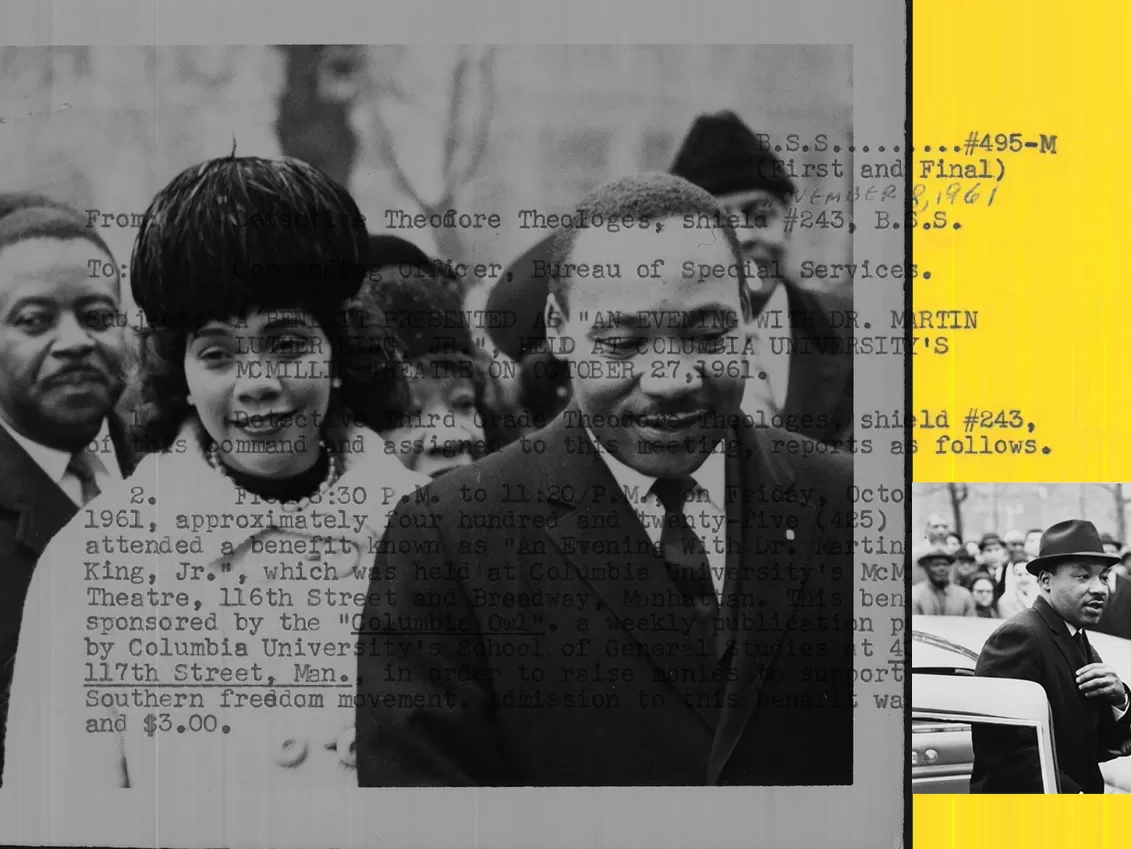
In the midst of the civil rights movement, one man stood out as a beacon of hope and inspiration for millions of people across the United States. Martin Luther King Jr., a Baptist minister and activist, dedicated his life to fighting for racial equality and justice. His powerful speeches and nonviolent protests captured the hearts and minds of the American people, and he became a symbol of hope for a better future.
However, not everyone saw Dr. King in the same light. J. Edgar Hoover, the infamous director of the Federal Bureau of Investigation (FBI), saw him as a threat to the status quo and launched a campaign to discredit and undermine him. In a shocking turn of events, it has recently been revealed that the New York Police Department (NYPD) joined in on this campaign by conducting extensive surveillance on Dr. King and his associates.
Newly unveiled photos of Dr. King show the depth of the NYPD’s surveillance and the extent to which they went to monitor his activities. These photos, obtained by The Intercept, show Dr. King and his close associates being followed and photographed by undercover officers. They also reveal that the NYPD’s spy unit, known as the Bureau of Special Services and Investigations (BOSSI), heeded Hoover’s call to target Dr. King and his organization, the Southern Christian Leadership Conference (SCLC).
This revelation has sparked outrage and renewed calls for accountability and transparency from law enforcement agencies. It is a stark reminder of the dark history of government surveillance and the violation of civil rights in the name of national security. The fact that the NYPD, a local police department, was involved in this surveillance operation is particularly concerning and raises questions about the extent of their involvement and the justification for their actions.
The photos also shed light on the tactics used by the NYPD to gather information on Dr. King and his associates. Undercover officers were deployed to infiltrate the SCLC and gather intelligence on their activities. They also monitored their phone calls and kept detailed files on their movements and interactions. This level of surveillance is not only a violation of privacy but also a clear attempt to intimidate and discredit Dr. King and his message of equality and justice.
It is important to note that this surveillance was not limited to Dr. King alone. The photos also show other civil rights leaders, including Bayard Rustin and Ralph Abernathy, being followed and monitored by the NYPD. This further highlights the extent of the surveillance and the targeting of the civil rights movement as a whole.
The revelation of these photos is a powerful reminder of the sacrifices made by Dr. King and other civil rights leaders in their fight for equality. It is a testament to their courage and determination in the face of adversity and oppression. Despite the constant surveillance and harassment, Dr. King continued to lead the civil rights movement and inspire millions of people to join the fight for justice.
As we reflect on the legacy of Dr. King and the civil rights movement, it is important to acknowledge the role of government surveillance in hindering their progress. It is a reminder that we must remain vigilant in protecting our civil liberties and holding those in power accountable for their actions. The NYPD’s surveillance of Dr. King and other civil rights leaders is a dark chapter in our history, but it serves as a powerful reminder of the importance of standing up for what is right and just.
In the words of Dr. King, “Injustice anywhere is a threat to justice everywhere.” The surveillance of Dr. King by the NYPD was not just an attack on one man, but an attack on the very principles of equality and justice that he stood for. It is our responsibility to ensure that such violations of civil rights do not happen again and that the sacrifices made by Dr. King and other civil rights leaders are not in vain.
In conclusion, the newly unveiled photos of Dr. King and the extent of the NYPD’s surveillance on him and the civil rights movement are a powerful reminder of the challenges faced by those who fight for justice and equality. It is a call to action for us to continue the work of Dr. King and to never forget the sacrifices made by him and others in the pursuit of a better and more just society. Let us use this revelation as a catalyst for change and strive towards a future where government surveillance is not used as a tool to suppress and oppress marginalized communities.