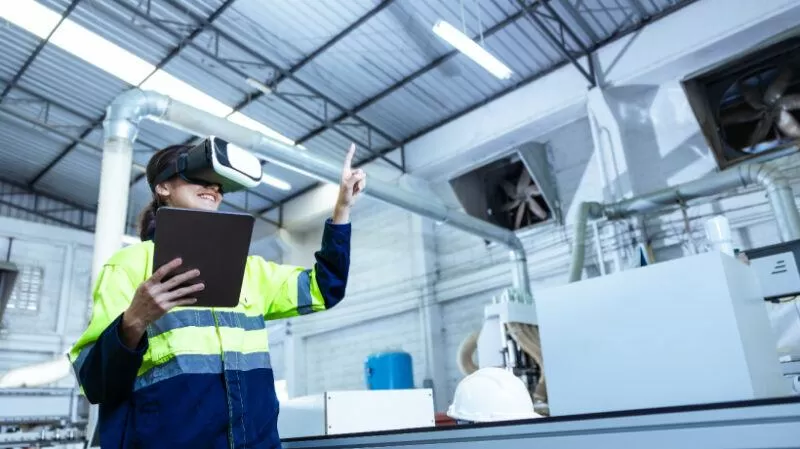
In the fast-paced world of modern manufacturing and logistics, traditional classroom training simply cannot keep up with the demands of the industry. The increasing complexity of processes and safety-critical tasks require a more hands-on approach to training. This is where immersive technologies, such as Virtual Reality (VR) and Augmented Reality (AR), have emerged as game-changers in the field of employee training.
Immersive technologies offer a highly realistic and interactive learning experience that goes beyond the limitations of traditional training methods. With VR and AR, employees can practice in a risk-free environment, develop skills faster, and transfer knowledge more effectively. This has proven to be immensely beneficial for both employers and employees.
One of the key advantages of using immersive technologies in training is the ability to provide a realistic simulation of real-life scenarios. For manufacturing and logistics roles, where hands-on training is crucial, this can be a game-changer. VR and AR can replicate the exact working conditions, equipment, and machinery that employees will encounter on the job. This allows them to get a feel of the actual work environment and familiarize themselves with the equipment and processes before they even step foot on the production floor.
Moreover, immersive technologies provide a risk-free environment for employees to practice their skills. In high-risk industries like manufacturing and logistics, mistakes can have serious consequences. With VR and AR, employees can make mistakes and learn from them without any real-world repercussions. This not only ensures their safety but also boosts their confidence and competence in handling critical tasks.
Another significant advantage of immersive technologies is the speed at which skills can be developed. Traditional classroom training can be time-consuming and often requires employees to travel to training facilities. This can be a significant barrier for companies with a large workforce or those with multiple locations. With VR and AR, employees can access training from anywhere, at any time, and at their own pace. This eliminates the need for travel and can save a considerable amount of time and money for both employers and employees.
Furthermore, immersive technologies enable a more engaging and interactive learning experience. Traditional training methods, such as lectures and videos, can be dry and monotonous, leading to low retention rates. On the other hand, VR and AR offer a highly interactive and gamified learning experience that keeps employees engaged and motivated. This leads to better retention of knowledge and skills, resulting in a more skilled and efficient workforce.
In addition to faster skill development, VR and AR also facilitate stronger knowledge transfer. With traditional training, it can be challenging to ensure that all employees have received the same level of training and have the same understanding of the material. However, with immersive technologies, training modules can be standardized, ensuring that all employees receive consistent and accurate information. This leads to a more knowledgeable and competent workforce, which ultimately benefits the company’s bottom line.
Moreover, immersive technologies also offer a cost-effective solution for employee training. Traditional training methods, such as hiring external trainers or sending employees to training facilities, can be expensive, especially for companies with a large workforce. On the other hand, VR and AR training can be easily scaled and replicated, making it a more cost-efficient option in the long run.
It is also worth noting that immersive technologies are not limited to technical skills training. They can also be used for soft skills training, such as communication, leadership, and teamwork. This is particularly useful for manufacturing and logistics roles, where effective communication and teamwork are essential for smooth operations.
In conclusion, the use of immersive technologies in employee training has revolutionized the way modern manufacturing and logistics companies approach training. It offers a realistic, risk-free, and engaging learning experience that leads to faster skill development, stronger knowledge transfer, and cost savings for companies. As technology continues to advance, we can expect to see even more innovative and effective uses of VR and AR in the training and development of employees. So, it’s time for companies to embrace these immersive technologies and stay ahead in the competitive world of manufacturing and logistics.